Cato Manor
Starting in 2011, we published a series of articles examining accusations that members of the Cato Manor police unit in Durban were operating as a death squad.
The story began with a tip-off my colleague Mzilikazi wa Afrika and I received from former police commissioner Jackie Selebi over a year earlier, in August 2010. We visited him at his home in Pretoria shortly after Mzi was arrested on trumped up charges after we’d exposed Selebi’s successor, Bheki Cele, for his role in two dodgy real estate deals worth R1.7 billion. Though Selebi was convicted of corruption himself, he expressed the view that Zuma and his henchmen such as Cele were turning South Africa into a gangster state. Among the claims he made against Cele was that he was running a death squad in KwaZulu-Natal.
We didn’t pay much heed to Selebi’s allegation until we coincidentally received an email from veteran human rights defender Mary de Haas about a month later. She told us taxi operators in KZN lived in fear of their lives after receiving death threats from industry rivals colluding with certain police members. In particular, they singled out a detective from the Cato Manor unit. Recalling our conversation with Selebi, we travelled to Durban, where De Haas introduced us to two taxi bosses in hiding, Dalisu Sangweni and Marandi Mthethwa. They told us about being harassed by Cato Manor detectives taking sides in taxi conflicts. Mthethwa played us a recording of one of them threatening to kill him.
Gathering evidence
Over the next year, the two taxi bosses introduced us to other taxi operators with similar complaints (Mthethwa and Sangweni were subsequently killed in what De Haas described as “taxi-related violence”).
De Haas later introduced us to other human rights campaigners, including from Amnesty International, and experts helping families bring civil cases against Cato Manor detectives. The police have since lost one of these. We also spoke to reporters in or from KZN who had investigated Cato Manor killings. They introduced us to several more sources, including two insiders.
Our notebook entries and email correspondence show that we spent over a year conducting more than 40 interviews, often with people who had direct or expert knowledge of events – we were not simply handed a dossier, as has sometimes been alleged.
After another spate of suspicious Cato Manor killings in 2011 the SA Communist Party called for a commission of inquiry into the unit, which it accused of resorting to “Vlakplaas-style” executions rather than taking suspects to court. By then Rob Rose had joined Mzi and I in our research.
By the time we published our first Cato Manor story in December 2011, we had gathered evidence suggesting the unit was involved in at least 30 suspicious deaths over four and a half years, mostly of people living in poor townships or rural villages in KZN. Our research showed that 16 of these deaths were of suspected cop-killers. A judicial inquiry clearly stood a better chance of getting to the bottom of this suspicious pattern of killings than a compromised or inept police oversight system. We hoped our story would create public pressure for such an inquiry.
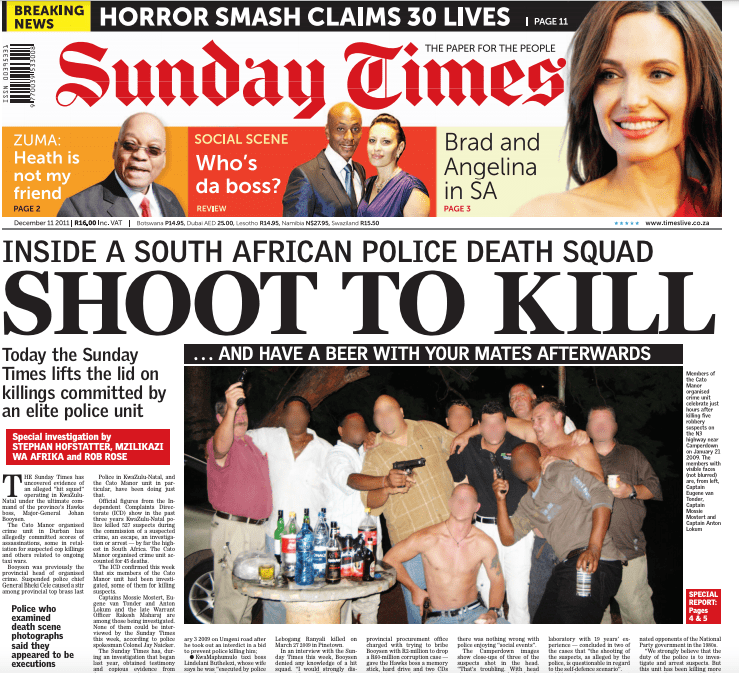
Instead of an inquiry, the politically corrupted criminal justice system launched an ill-conceived, amateurishly executed racketeering case against the detectives and the unit’s founder, Johan Booysen.
Diverting attention
Since then Booysen has steadfastly maintained that the Cato Manor case was fabricated to neutralise him so that he wouldn’t go after Thoshan Panday, a business associate of former president Zuma’s son Edward Zuma. But available evidence suggests it is equally if not more plausible that Booysen was initially reluctant to pursue Panday to protect Bheki Cele, a close ally allegedly instrumental in Booysen’s promotion, and that Booysen only went after Panday to opportunistically cast himself as a whistle blower on corruption when it suited him (details can be found here).
Booysen subsequently launched a well-orchestrated campaign to discredit our stories, which culminated in their retraction by the Sunday Times in October 2018 and the awards they won being returned. In doing so, he has routinely misrepresented the journalistic processes we followed in writing the Cato Manor stories.
For example, he told the Zondo commission that we said he had used a police helicopter to block a vehicle on the N3 so that his men could shoot the occupants “almost like in the movies”. Booysen said his version was that he was sitting in his office at the time of the shooting and that he “only heard about it afterwards”. Booysen said we could easily establish that his version was correct by consulting the police air wing logs, but we refused because we’d already made up their minds what to write (Booysen transcript, 18 April 2019, pp 87-89).
All of this is pure fabrication. We never said Booysen had blocked a vehicle on the N3 in a helicopter so that his men could shoot the occupants. The story we wrote clearly states that Booysen landed at the scene after the shooting. It would be absurd to consult the helicopter logs to disprove an allegation we never had any intention of making. What’s more, an affidavit later submitted by an air crew member suggests that the helicopter was actually sent to pick up Booysen during the pursuit, not after the shooting was over, as he has claimed to the Zondo commission (supporting documents can be found here).
A more detailed discussion of Booysen’s misrepresentations can be found in an article I wrote for The Journalist magazine: Why we still need a judicial inquiry into the Cato Manor killings.
Discrediting the evidence
Booysen also sought to undermine the stories with the false claim that the pictures of shootings we obtained were all routine police photos that didn’t reveal anything incriminating. This, according to ballistics experts and police sources we consulted, is patently untrue – at least where some of the photos are concerned. The experts pointed to particular photos that were suggestive of the use of excessive force, crime scene tampering and extrajudicial killings. Among the experts was Captain Chris Mangena, who was widely praised for his exemplary work in the Oscar Pistorius trial (more details of Mangena’s findings in the Cato Manor case can be found here. Caution advised for sensitive readers).
‘The deceased landed first on the ground and was bleeding for some time and then a firearm was placed on top of [the] blood’
Captain Chris Mangena, SAPS ballistics expert
Lastly, Booysen sought to discredit the whistleblowers who spoke to us – notably former Cato Manor reservist Ari Danikas. A former confidant of Booysen’s, he has provided prosecutors with a large amount of hard evidence that has never been tested in court (more details can be found here).
The international freedom of expression advocacy group Blueprint for Free Speech, after thoroughly vetting his evidence, bestowed a special recognition award on Danikas for blowing the whistle on human rights abuses by Cato Manor members. Despite this, at Booysen’s instigation, several journalists have sought to smear Danikas. The most recent example was Jacques Pauw, in an article published by Daily Maverick in August 2020. In May 2021 Danikas, with the help of social worker John Clarke and lawyer Richard Spoor, won an ombuds complaint against Pauw, who was forced to apologise.
John Clarke has provided a detailed account of the whole episode here.
Subsequent to this, prominent FBI whistleblower Jane Turner has joined her CIA counterpart John Kiriakou in paying tribute to Danikas for exposing human rights abuses by the Cato Manor unit. In June 2021 Turner, a highly decorated former FBI special agent, featured Danikas as her “whistleblower of the week” in the US online publication, Whistleblower Network News.
‘I’m honored to know Aris Danikas. He is an underappreciated whistleblower who, at great risk to his own safety and security and that of his family told the truth about human rights abuses being perpetrated by the police in South Africa.’
John Kiriakou, CIA torture whistleblower
The Sunday Times retraction of the Cato Manor stories is often incorrectly used as grounds to dismiss them in their entirety as fake news. Actually, there were two factual errors in 28 articles and 20 photos published over four years (a photo was used incorrectly and a court document misquoted), but neither was fatal to the story and both were corrected by the newspaper many years before the retraction.
Branding the story fake news is an insult to the dozens of families of those killed and is not supported by a subsequent inquiry into media ethics, headed by Judge Kathy Satchwell.
The Satchwell inquiry pointed out that the sources we relied on “have not been discredited and one of the prime sources, Mary de Haas, has publicly confirmed her information. More than 40 people are dead and the Hawks and the NPA all conducted their own investigations resulting in prosecutions.” The Satchwell report pointed out that “these were not figments of the imagination of the journalists involved,” describing the testimony of community members and human rights activists unconnected to the Sunday Times as “compelling”(paragraphs 8.138 and 8.206).
‘The sources upon which the reporters relied in the Cato Manor stories have not been discredited’
Satchwell inquiry
More details of the evidentiary basis of our Cato Manor reporting can be found in my article here.
The intriguing back story to the spectacular about-turn in 2018 by the Sunday Times, which had previously staunchly defended the story, only came to light after the Satchwell inquiry published its report in 2021. In essence, the Satchwell report concluded the retraction had more to do with “politico-financial” considerations than any editorial concerns (more details can be found here).
Never tested in court
By then a National Prosecuting Authority panel appointed to review the Cato Manor prosecution had, unsurprisingly, found that it was deeply flawed. The racketeering charges were withdrawn and more than 20 individual murder dockets referred back to the KZN prosecutions office, which declined to prosecute any of them.
This came as a great shock to IPID investigators, whistleblowers, witnesses and family members, some of whom were present during the shootings. They have supplied enough evidence to suggest that some of these detectives were involved in a large number of suspicious killings. This evidence has yet to be tested in court. Meanwhile, the investigators and whistleblowers, including Ari Danikas, have been targeted and victimised.
Blueprint for Free Speech continues to stand by the award it gave to Danikas for blowing the whistle on Cato Manor human rights abuses. Subsequent to the withdrawal of the charges against the detectives, the advocacy group called for “an impartial judicial review led by a panel of eminent jurists, such as retired judges from an international court, who are completely independent of the complex party politics of South Africa”. Blueprint pointed out that “Danikas’ disclosure raises numerous public interest matters that deserve proper independent investigation; extra-judicial killing by an arm of the state offends the basic rights of any citizen. It is important for the citizenry to be able to have confidence in the rule of law, and those who enforce it.”
‘The allegations brought against the squad should be dealt with in a transparent manner. [They are] serious enough to need an impartial judicial review led by a panel of eminent jurists, such as retired judges from an international court, who are completely independent of the complex party politics of South Africa.’
Blueprint for Free Speech
As I wrote in my article for The Journalist in December 2020, I remain convinced that the actions of the Cato Manor unit still merit a thorough, professional criminal investigation and, where warranted, prosecution — one that is not tainted by political manipulation. The rule of law must apply equally to all, without fail, if we are to restore faith in the criminal justice system. As with the TRC cases of apartheid-era crimes that are finally reaching the courts, the family of every person killed unjustifiably – including an innocent victim shot dead in his own home when the Cato Manor cops stormed the wrong house – deserves justice one day too.
Evidence list
- Cele’s signature on Panday deal
- Affidavit from Panday investigator
- 2010 Panday investigation memo
- Helicopter flight documents
- Report by SAPS ballistics expert, Captain Chris Mangena (warning: graphic content)
- Pictures showing a dead suspect’s body was moved (warning: graphic content)
- Videos of a suspect being allowed to bleed to death (warning: graphic content)
- Videos of a suspect being tortured (warning: graphic content)
This is a small sampling of the large volume of evidence in my possession and available to prosecutors
 stephanhofstatter.com
