Renditions
The first controversial story I became embroiled in at the Sunday Times involved Zimbawean security agents taking crime suspects across the border illegally to Zimbabwe, where they were killed. It came to be known as the “renditions story“.
The story began with a call-in to our office in 2011 from a policeman who said he wanted to blow the whistle on members of an elite South African police division, the Hawks, implicated in the deaths of Zimbabwean citizens. My colleague Rob Rose took the call and went to meet the source. We discussed it and decided there wasn’t enough material to prove the case.
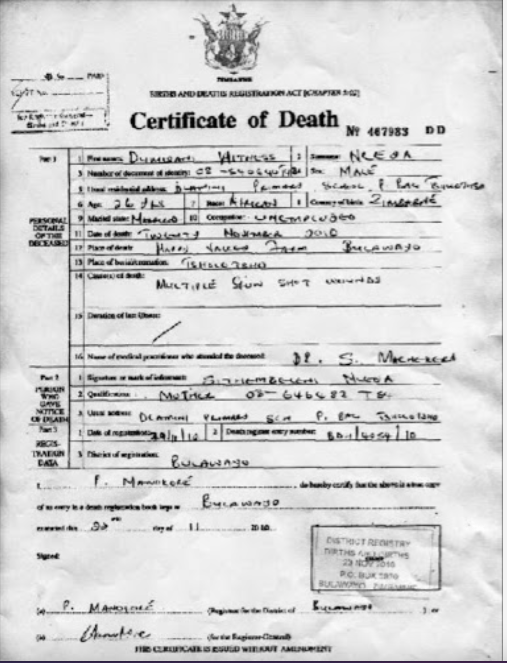
Next we asked the source to provide more evidence, which he did. This included occurrence book entries, a death certificate, and witness statements. The evidence showed three Zimbabwean citizens had been arrested for being illegal immigrants and detained at Orlando police station in Soweto before being discharged at 11.55am two days later and driven to Beit Bridge border post rather than Lindela repatriation camp.
The source also put us in touch with friends and relatives of the Zimbabweans, and others who were arrested by the same Hawks members but later released. My colleague Mzilikazi wa Afrika interviewed them.
A statement by one of the Zimbabweans related how the arresting officers had simply handed the three to Zimbabwean authorities, who said they were wanted for the deaths of police officers in that country. The evidence suggests one of them, Witness Ndeya, was killed by the Zimbabwean security forces. The source told us there were other cases of Zimbabweans who had been taken across the border in this fashion, and disappeared. We wrote about two of them.
Subsequent investigations showed that the controversies surrounding the renditions story had more to do with politics than editorial issues.
In essence, Anwa Dramat, who was the head of the Hawks when the story broke, claimed the case was being used to derail him from investigating Jacob Zuma, then president of the country, for corruption related to security upgrades worth R248 million at his Nkandla residence.
An inquiry headed by retired judge Kathy Satchwell later pointed out that there is no dispute that Zimbabwean security agents and members of the Hawks worked together, “probably unlawfully”, to transport crime suspects from South Africa to Zimbabwe, “where they were allegedly murdered” (paragraph 8.21). What is in dispute is who was responsible – specifically, whether senior Hawks officials, including Dramat, were involved alongside other more junior members.
Satchwell inquiry
‘There was no dispute that Zimbabwe security agents and members of SAPS worked together, probably unlawfully, to transport criminal suspects from South Africa to Zimbabwe, where they were allegedly murdered.’
An initial report into the case by the Independent Police Investigative Directorate (IPID) implicated Dramat as well as the junior members of the Hawks, recommending all should be criminally charged. A subsequent report exonerated Dramat but not the junior officers.
The law firm Werksmans was then appointed to investigate the case. It found Dramat had a case to answer and should be charged. In addition to this, the Werksmans investigation found that the newly appointed head of IPID, Robert McBride, should also be charged for altering the original report to exonerate Dramat. Werksmans later told the Zondo Commission of inquiry into state capture that it stood by its work and conclusions in the renditions matter.
No journalistic errors of fact or process have been found with the renditions stories, as some have falsely written or claimed. This is supported by the fact that, as the Satchwell inquiry pointed out, “there were no complaints, threats of legal action, or demands for an apology in respect of the Zimbabwe rendition series and no retraction or apology was ever offered by the Sunday Times” (8.20).
 stephanhofstatter.com