SARS rogue unit
Perhaps the most damaging story I have ever been associated with concerned a unit at the South African Revenue Service (SARS) accused of illegally spying on taxpayers, politicians and prosecutors.
The story was initiated at different times in 2014 through separate investigations by Malcolm Rees, under the Business Times editorship of Rob Rose, and Piet Rampedi, who had joined the newspaper’s investigations unit. Later Mzilikazi wa Afrika and I were assigned to help (an account of how the story originated can be found here).
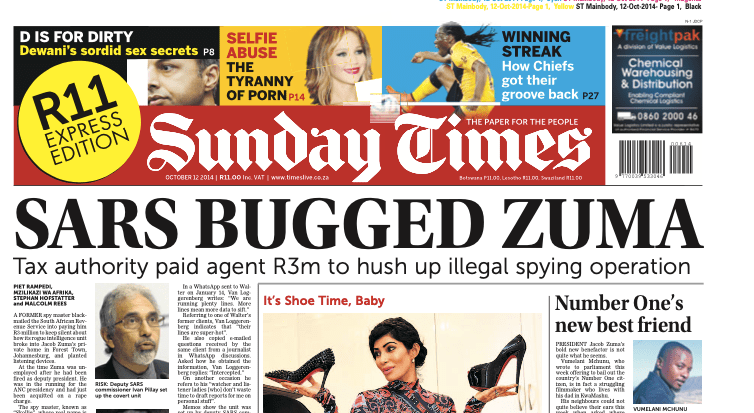
Rampedi soon bumped heads with Rees, who felt cut out of a story that he had in part originated. He also felt alienated by Rampedi’s secretive, defensive and bullying style of working with his colleagues. It left Rees uncertain about where the story was headed and his role in it. This prompted him to resign from the Sunday Times at the end of 2014, leaving Rampedi as the driving force of the SARS rogue unit narrative.
This is not a case of pointing fingers at colleagues when a story hits a snag. The way Rampedi worked with us on SARS was totally different from way I had worked with my colleagues in the Sunday Times investigations unit before, and I have never worked that way since. During our very successful partnership prior to Rampedi’s arrival, Mzi, Rob and I always fully briefed each other about our sources. When possible, we attended meetings together. We also happily interrogated each others’ evidence, assumptions and possible confirmation bias, saving each other from potential embarrassment.
Working with Rampedi was an entirely different matter. He was not comfortable being open with his colleagues or having his work interrogated. He was defensive and hostile to the slightest bit of criticism, and resorted to bullying, insults and name-calling when anyone dared to disagree with him. This made for a very fraught working relationship throughout the SARS rogue unit period.
In the background to all of this, my personal life was in crisis and my marriage was falling apart. In hindsight, I should probably have taken some time off work. I did not, and my performance suffered. I was less focused than usual, to put it mildly, and applied less rigour in my work than I may otherwise have.
Errors of fact and process
We did make errors of fact and process with the SARS rogue unit stories. They were rushed and sensationalised; allegations were treated as fact; we didn’t spend enough time hearing the other side (although many officials said at the time that they were barred from talking to media); no proper context was provided; and no space was given to a counter narrative. There were also some material errors of fact and emphasis.
I did not originate the stories and was never the lead writer. But I did take part without employing enough professional rigour and care – something I regret to this day. That is why I publicly apologised for what role I played.
Even so, I can provide proof that I urged caution on how the stories were being run.
The stories had major repercussions. They demoralised SARS, derailed important tax probes, and helped some allies of Jacob Zuma and Julius Malema. None of these were foreseen, intended, or malicious. As Judge Kathy Satchwell made clear in her report for the inquiry into media ethics: “No evidence has been produced that the journalists … were knowingly complicit [in being manipulated] and intended to disinform and cause damage.” (paragraph 8.163).
‘No evidence has been produced that the journalists … were knowingly complicit [in being manipulated] and intended to disinform and cause damage.’
Satchwell inquiry
The Satchwell inquiry also concluded that, notwithstanding our errors, five investigations “all found the SARS unit to have been unlawfully established, which meant that the journalists were reporting on what – at the time, although their status has since changed – were considered authoritative findings on a matter of considerable public interest” (paragraph 8.206).
In 2016 Rampedi resigned from the Sunday Times when the new editor Bongani Siqoko began speaking to SARS members about retracting the stories, without involving any of the writers. When Rampedi left, he took all his SARS documentation with him. This left Mzi and I carrying the can, without any supporting evidence, when the Sunday Times was negotiating a retraction and apology.
Afterwards I spent over a year interacting in person with one of the unit’s former heads, Johann van Loggerenberg, together with Malcolm Rees and Rob Rose, to figure out what went wrong with our reporting. For the most part it felt like an amicable, sincere joint effort to get to the truth. I learned of actions by State Security Agency agents and details of dirty tricks campaigns run by cigarette smugglers that I hadn’t known about. Some were intent on derailing tax probes, others on protecting their political principals.
I apologised personally to Van Loggerenberg for what role I played in the stories not being done more professionally, for not spending enough time to hear his version prior to publishing, and for the personal trauma he’d been caused by how we hounded him.
At the time he seemed amenable to accepting my apology. I only discovered afterwards he was not. What he really wanted was for me to declare that every word we had written about SARS was fake news, which is not true. For example, some members of the unit did admit to planting bugging devices in 12 offices and boardrooms at the National Prosecuting Authority headquarters in Pretoria in 2007, before Van Loggerenberg took over, as part of factional battles playing out in the ANC over the Selebi trial. It was legitimate and in the public interest to publish this fact.
Accepting that I made mistakes in the SARS story, and having apologised for that, I believe I still have a contribution to make as a journalist. The story should be weighed against my work as a journalist over two decades. I have written or contributed to literally hundreds of stories and two books that have exposed corruption and abuse of power at the highest levels – before and after the SARS story was published. Many of these resulted directly in corrupt deals being halted and led to implicated officials being removed from their posts and, in some cases, convicted of their crimes.
I hope that my role in the SARS story will not be used in perpetuity to stop me from doing my job, which is holding those in power to account, without fear or favour.
 stephanhofstatter.com